
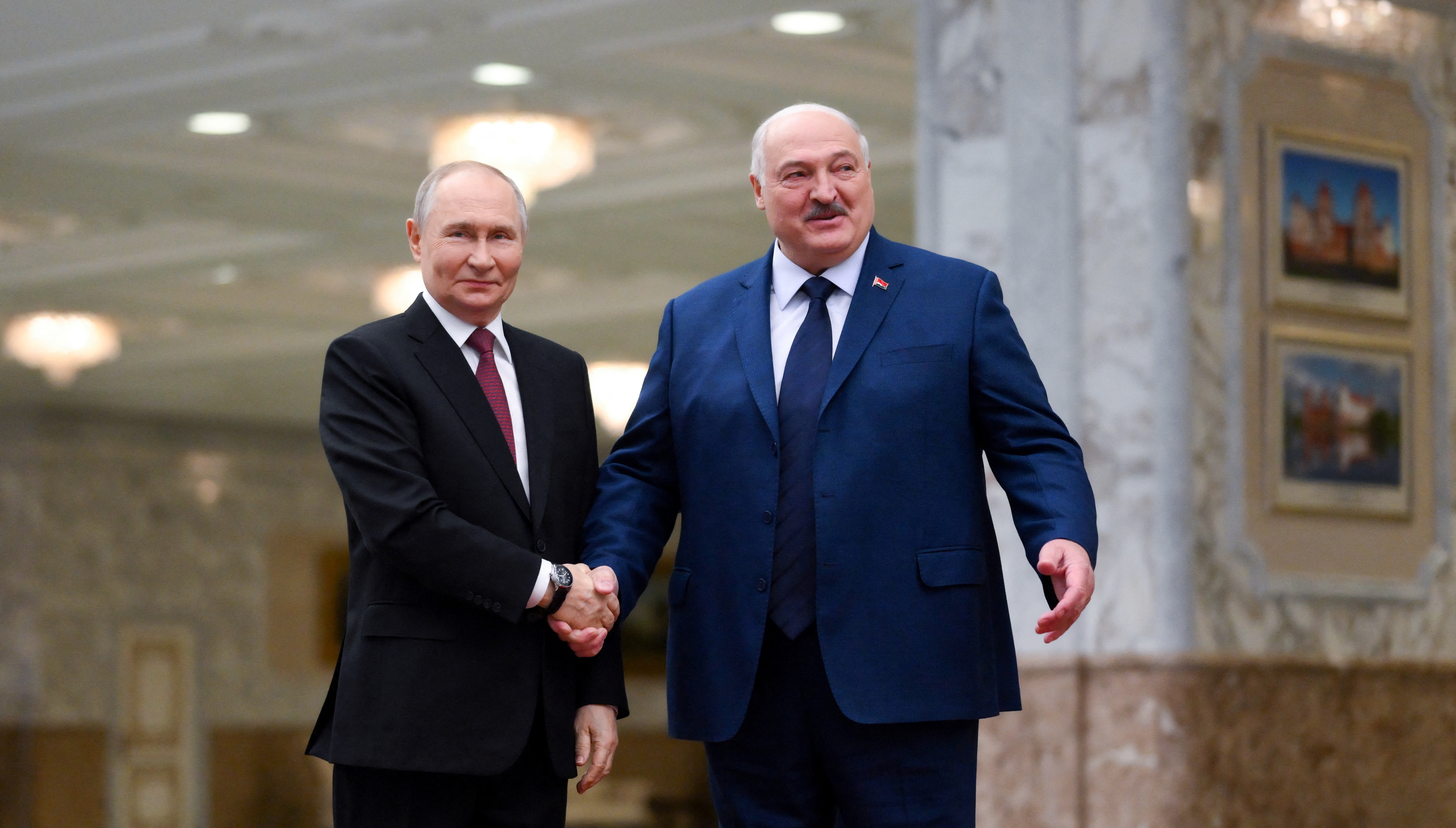
Russian President Vladimir Putin has confirmed that one of the country’s most advanced hypersonic missile systems has officially entered active service and will soon be stationed in Belarus. The announcement marks a significant step in Russia’s ongoing effort to modernize its strategic military capabilities and deepen defense ties with its closest ally in the region.
Based on remarks given in a recent top-tier meeting, the missile—designed to achieve very high speeds while avoiding contemporary defense mechanisms—has finished its ultimate test stages and is now deemed ready for operation. The strategy includes positioning the weapon in Belarus, a step that might alter the security dynamics on NATO’s eastern edge.
The decision to deploy the hypersonic missile in Belarus reflects a broader trend of increasing military coordination between Moscow and Minsk. Over the past two years, Russia and Belarus have expanded joint training operations, established shared air defense systems, and agreed on deeper logistical cooperation within their respective armed forces.
Positioning advanced weaponry on Belarusian soil is likely to be seen as a gesture of trust between the two countries, but also a strategic signal to Western powers. Belarus, which borders several NATO member states, serves as a key location for Russia’s regional military posture. By introducing cutting-edge missile systems into this zone, Moscow appears to be reinforcing its deterrent capabilities amid ongoing tensions with the West.
Although specific information is scarce, Russian defense representatives have highlighted the missile’s velocity and agility as critical attributes. Hypersonic arms are characterized by their capability to move at velocities beyond Mach 5, or five times the speed of sound, and are usually fitted with advanced navigation systems that enable them to avoid being detected and intercepted.
Russia has developed multiple hypersonic platforms in recent years, including the Avangard glide vehicle, the Kinzhal air-launched missile, and the Zircon cruise missile. It remains unclear which specific system is being referred to in this latest announcement, but analysts suggest it could be a ground-based version or a modified variant tailored for regional deployment.
Such systems are considered particularly difficult for existing missile defense architectures to counter, due to their combination of high velocity, unpredictable flight paths, and low atmospheric trajectories. This capability enhances not only Russia’s first-strike potential but also its ability to target high-value installations with minimal warning.
The intended deployment of hypersonic missiles in Belarus has raised worries among NATO states, particularly those situated in Eastern Europe. Nations like Poland, Lithuania, and Latvia, which all share borders with Belarus or Russia, are expected to perceive this action as a major intensification.
NATO has previously expressed apprehension over Russia’s deployment of advanced weapons systems near alliance borders, citing the potential for destabilization and miscalculation. This latest development could lead to calls for enhanced missile defense capabilities in the region and further military readiness exercises among allied forces.
For Belarus, allowing the deployment of Russian hypersonic missiles represents a deepening of its dependence on Moscow—not only politically, but also militarily. Following the contested 2020 presidential election and subsequent sanctions from the West, Belarusian President Alexander Lukashenko has leaned heavily on Kremlin support to maintain domestic stability. That support now extends to the country’s defense infrastructure.
Putin’s announcement comes at a time of heightened geopolitical tension, particularly in light of the ongoing conflict in Ukraine and continued strains between Russia and Western governments. Hypersonic weapons have played a growing role in Russia’s strategic messaging, often highlighted as evidence of the country’s technological superiority and readiness to confront perceived external threats.
The Kremlin’s disclosure of the operational readiness and upcoming deployment of this system in Belarus serves a dual purpose: domestically, it showcases their military capabilities, while internationally, it emphasizes Russia’s intent to extend its influence outside its own territory.
The declaration aligns with numerous diplomatic initiatives to tackle security challenges in Europe. However, the deployment of sophisticated missiles in the area might complicate these initiatives, particularly if perceived as violating current arms control treaties or challenging NATO’s shared security structure.
La comunidad internacional probablemente reaccionará con precaución y preocupación. Aunque no ha habido una respuesta inmediata desde la sede de la OTAN, los estados miembros han solicitado anteriormente una mayor claridad en las prácticas de desarrollo y despliegue de armas de Rusia. Algunos funcionarios occidentales sostienen que las armas hipersónicas añaden un nuevo nivel de inestabilidad, ya que acortan los plazos para la toma de decisiones y disminuyen la eficacia de las estrategias basadas en la disuasión.
Este despliegue también podría aumentar la presión sobre los ya tensos mecanismos de control de armas. Importantes acuerdos como el Tratado de Fuerzas Nucleares de Alcance Intermedio (INF) se han desmoronado en los últimos años, y las perspectivas para futuras negociaciones de control de armas son inciertas. La incorporación de sistemas hipersónicos en Bielorrusia podría complicar más el diálogo futuro, especialmente si los países vecinos ven este movimiento como una amenaza directa.
Additionally, the stationing of these weapons near Europe raises questions about the role of missile defense systems and whether current architectures are sufficient to address emerging threats. Nations may now consider bolstering radar coverage, updating intercept capabilities, and revising early warning protocols.
From a doctrinal perspective, the deployment indicates a transformation in Russia’s perspective on the function of weapons stationed ahead of the front lines. Initially regarded mainly as protective measures, contemporary hypersonic systems now possess an offensive strategic role as well. Their presence in Belarus may provide swift strike capabilities against nearby objectives, such as infrastructure, command centers, and military deployments.
Esta reorientación altera el equilibrio estratégico en Europa del Este, especialmente en un momento en que las tensiones regionales permanecen elevadas. Los planificadores militares en los países vecinos quizás ahora deban considerar la posibilidad de ataques hipersónicos que provengan de una mayor cercanía que nunca, lo que reduce el tiempo de reacción y complica la planificación defensiva.
Russia is still developing its strategy to incorporate these systems into its overall military framework; however, the deployment in Belarus seems to be a component of a bigger plan to expand Russia’s influence while reducing Western presence in the area.
President Putin’s announcement that a new hypersonic missile system is now operational and will be stationed in Belarus represents a notable development in Russia’s defense strategy. This action bolsters the partnership with Belarus, accentuates its influence in the region, and adds a formidable new element to the European security landscape.
As the international community assesses the implications, questions around arms control, deterrence, and escalation will take center stage. Whether this signals a new phase of military posturing or a longer-term shift in regional defense planning remains to be seen. But for now, the deployment sends a clear message: Russia is committed to expanding its strategic capabilities, even as tensions in the region continue to escalate.