
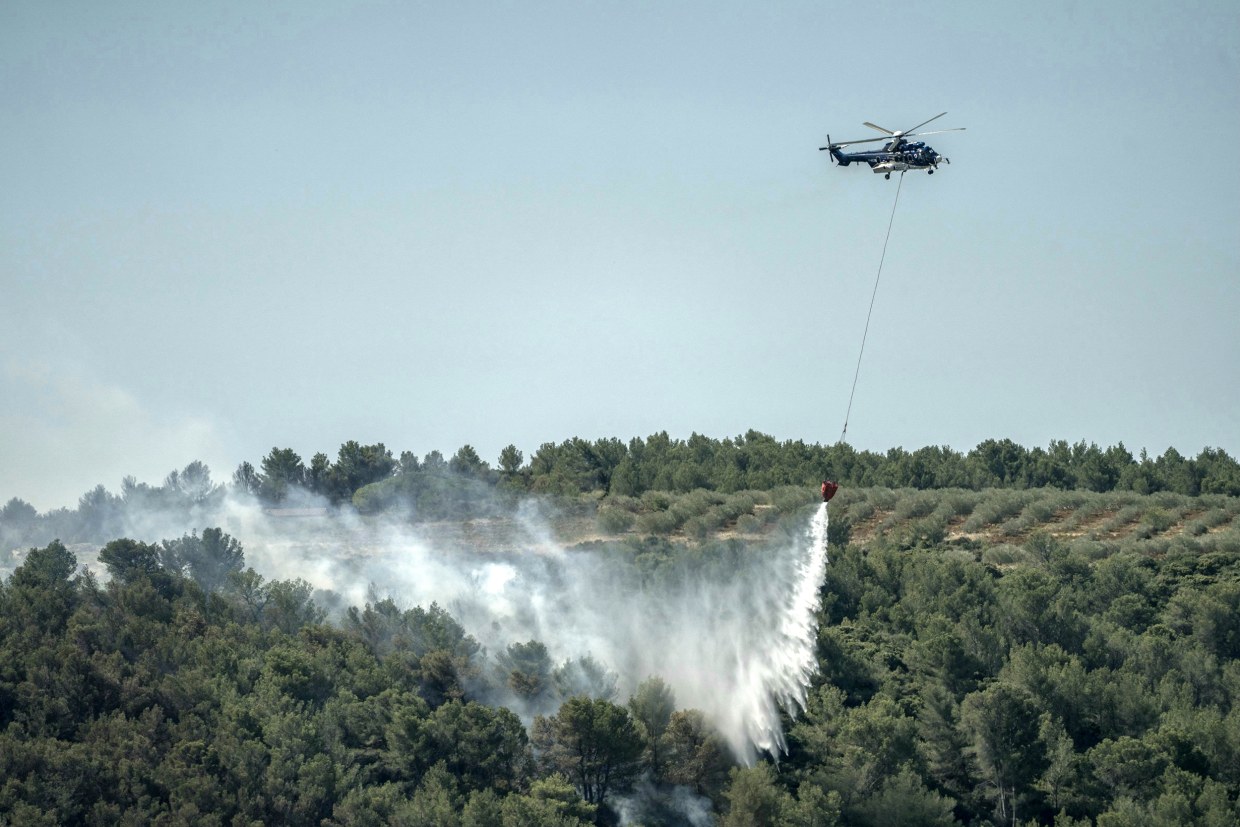
An unprecedented wildfire raging through France’s Mediterranean region has now consumed more land area than the entire city of Paris, with firefighters struggling to contain the rapidly expanding blaze. The inferno, which began in the arid hills near Saint-Tropez, has become the country’s most devastating wildfire this summer, destroying over 105 square kilometers of dense forest and scrubland – an area exceeding Paris’s 105 square kilometer footprint.
Firefighting crews from across Europe have mobilized to assist their French counterparts in battling the flames, which have shown alarming resistance to containment efforts. Nearly 1,200 firefighters supported by water-dropping aircraft have been working around the clock since the fire ignited three days ago, but shifting winds and tinder-dry conditions have allowed the fire to breach multiple containment lines. Local authorities report the blaze is advancing in several directions simultaneously, threatening new communities with each passing hour.
The fire’s rapid growth highlights the worsening wildfire risk across southern Europe, where climate change has created ideal conditions for catastrophic blazes. Meteorologists note this summer’s record-breaking heatwaves and prolonged drought have left vegetation bone-dry, allowing fires to ignite easily and spread at unprecedented speeds. The current wildfire has already forced the evacuation of over 10,000 residents and tourists from campgrounds, hotels, and villages in its path.
French President Emmanuel Macron visited the crisis headquarters in the Var department, pledging additional resources and vowing to “fight this disaster with every means at our disposal.” The government has activated the EU Civil Protection Mechanism, bringing specialized firefighting teams and equipment from Italy, Greece, and Germany to reinforce exhausted French crews.
Environmental scientists point to this blaze as a troubling example of how climate change is extending and intensifying wildfire seasons across the Mediterranean. “What we’re seeing is no longer an anomaly – it’s becoming the new normal,” explained Dr. Claire Bonnet of the French National Center for Scientific Research. “The combination of hotter temperatures, decreased rainfall, and more frequent extreme weather events has created conditions where fires of this magnitude can develop with alarming speed.”
The economic impact is already substantial, with the region’s vital tourism industry suffering cancellations during peak season and agricultural losses mounting in the famed Provence wine country. Insurance experts estimate damages could exceed €300 million, not accounting for long-term ecological consequences to the area’s biodiversity.
Fire behavior experts are observing extremely hazardous circumstances, as the flames are creating unique atmospheric conditions such as pyrocumulus clouds, which can cause unpredictable wind changes. Some firefighters have been hurt, but due to prompt evacuation measures, there have been no civilian fatalities. Several emergency shelters for residents forced to leave their homes have been set up by the prefecture, with assistance from the Red Cross in offering essential supplies and mental health support.
As climate projections indicate a growing threat of wildfires in southern Europe, this destructive blaze prompts essential inquiries about how forests are managed, the readiness for emergencies, and long-term plans for adapting to climate changes. At present, all endeavors are concentrated on safeguarding people and controlling the fire before it advances to more densely inhabited regions near the Côte d’Azur.
In the days ahead, the situation will become crucial as weather predictions indicate ongoing warm, arid conditions along with possible lightning storms that might ignite new fires. This emerging catastrophe highlights the urgent reality of climate change’s growing effects, turning scenic Mediterranean areas into highly flammable environments ready to ignite.