

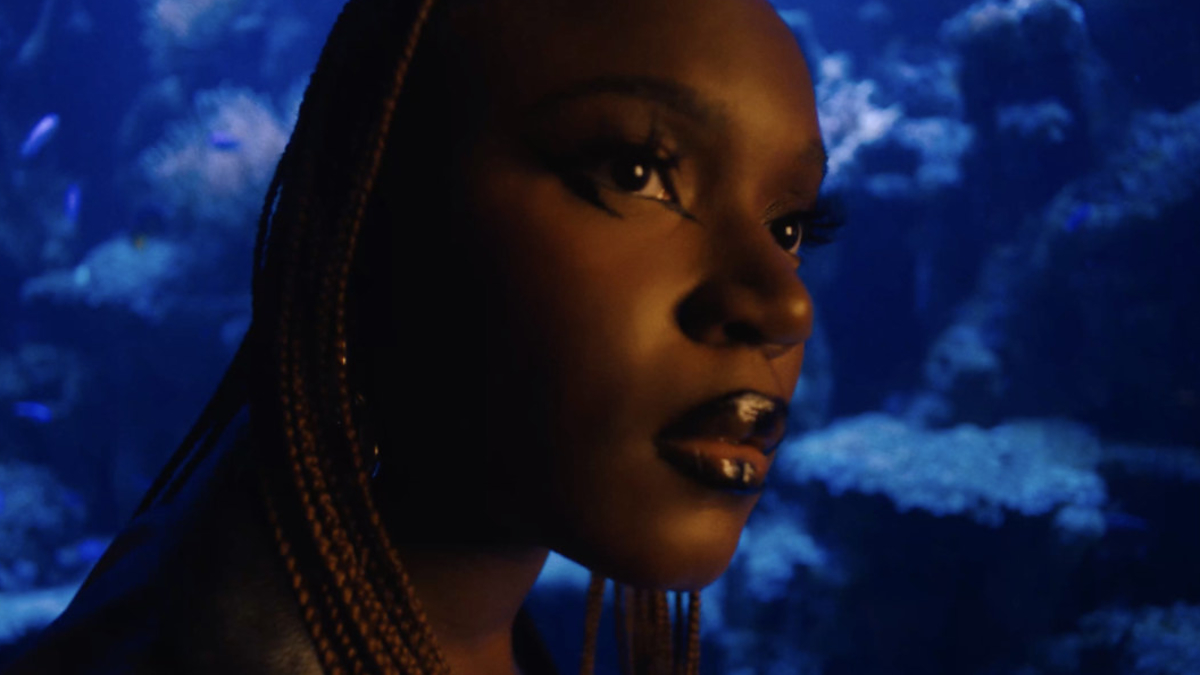
The Ghanaian-American musician Amaarae is recognized as a leading figure in modern music, known for her revolutionary approach that defies traditional genre limitations. Her latest album, Black Star, showcases her artistic growth and serves as a powerful declaration of her creative autonomy in an industry that frequently insists on classification.
Born Ama Serwah Genfi, the artist known for singing, songwriting, and producing has created a musical approach that skillfully merges aspects of Afropop, R&B, alternative rock, and electronic music. Her decision to defy typical genre boundaries has distinguished her artistic output. “Being confined to a category never resonated with my creative vision,” Amaarae elaborates. “Music is ever-changing, and I aim for my creations to mirror that changeability—the manner in which we genuinely encounter sound in reality.”
Black Star expands on the base established by her highly praised initial release in 2020, The Angel You Don’t Know, while exploring further experimental areas. The album’s name honors her Ghanaian roots—the black star is a key emblem in the country’s flag and cultural identity—while also indicating her cosmic aspirations for the scope and influence of the project.
Amaarae characterizes the album as her most intimate creation so far, drawing inspirations from her early years in Accra, her teenage years in Atlanta, and her current viewpoint as an international musician. The production process took place across various continents, with work sessions in Ghana, Nigeria, London, and Los Angeles that enabled her to work alongside a wide range of producers and artists.
“This album forced me to dig deeper into my own story while also thinking about music on a global scale,” she says. “I wanted to make something that felt true to my experiences but could also resonate with listeners from completely different backgrounds.”
The musical compositions in Black Star highlight Amaarae’s development as a producer. Songs transition fluidly between vibrant Afrobeats rhythms, atmospheric alt-R&B vibes, and surprising rock-inspired guitar strings. Her light, androgynous voice glides smoothly over these genre-crossing soundscapes, crafting an auditory experience that appears simultaneously forward-thinking and anchored in heritage.
Amaarae’s resistance to categorization has occasionally created challenges in an industry that relies heavily on genre classifications for marketing and radio placement. “There were definitely moments early in my career where executives would say, ‘This is great, but what is it? Where does it go?'” she recalls. “But I’ve always believed that if the music is strong enough, it will find its audience regardless of what box people try to put it in.”
This philosophy appears to be proving correct. Despite—or perhaps because of—its genre defiance, Black Star has garnered attention across multiple music scenes. The album’s lead single became an unexpected hit on both Afropop playlists and alternative radio stations, while the accompanying visual aesthetic (a mix of cyberpunk imagery and West African motifs) has sparked conversations in both fashion and contemporary art circles.
Amaarae’s work exemplifies what some critics have called “Afrofuturism 2.0″—art that acknowledges African traditions while imagining bold new possibilities for the continent’s cultural exports. “Growing up between Ghana and the U.S. gave me this dual perspective,” she explains. “I never saw African music as something separate from global pop. It’s all part of one continuum.”
This worldview manifests throughout Black Star. One track might sample a classic highlife guitar riff, while the next incorporates distorted 808s more commonly associated with trap music. The lyrics shift between English, Pidgin, and Twi, reflecting the multilingual reality of many young Africans today.
Amaarae’s success arrives at a time when African artists are enjoying unprecedented global visibility. However, she cautions against viewing this as a passing trend. “What’s happening now isn’t some sudden discovery of African talent,” she notes. “The infrastructure has been building for decades. The difference is that now we have more control over how our stories get told.”
This oversight is crucial to Amaarae’s method. She takes an active role in all facets of her profession, from producing to visual leadership. For Black Star, she gathered a team of creatives mainly consisting of African women and individuals from the diaspora, guaranteeing a genuine portrayal of her ideas.
While Black Star isn’t an explicitly political record, Amaarae recognizes that her presence as an androgynous, boundary-pushing African woman in the music scene holds meaning. “In certain contexts, simply being authentic can have an impact,” she notes. “I’m not intentionally creating political works, though I realize that for some audiences, witnessing someone like me succeed here seems groundbreaking.”
This subtle wave of silent defiance flows throughout the album’s lyrics, addressing themes of self-reliance, sexual liberation, and the intricacies of cultural identity. Amaarae’s lyricism harmonizes these profound subjects with witty language and captivating tunes, crafting music that is both intellectually stimulating and strikingly hip.
With Black Star garnering extensive praise from critics, Amaarae faces a significant turning point. The achievement of the album demonstrates there is a receptive audience for her innovative style, although the music industry is famously averse to artists who challenge straightforward classification.
“I am not concerned about it,” she remarks with her usual confidence. “The world is evolving. Today’s audience can listen to everything simultaneously—they might play an Afrobeats song, follow it with a punk tune, and then something experimental in the electronic genre. My music mirrors that situation.”
As for what comes next, Amaarae hints at expanding into film scoring and fashion design, though music remains her primary focus. “Right now I’m just enjoying this moment,” she says. “It took me a long time to make something that felt truly representative of all my influences, and to see people connecting with it is amazing.”
One thing seems certain: whatever direction Amaarae’s career takes next, it won’t be constrained by expectations or genre limitations. In an era of increasing musical homogenization, her commitment to creative freedom feels both refreshing and necessary. Black Star doesn’t just announce Amaarae’s arrival as a major artist—it suggests exciting possibilities for where global pop music might go next.
The album acts as both an individual expression and a wide-ranging reflection on the progression of art in today’s digital era. With streaming and social platforms continually dissolving geographical and stylistic boundaries, musicians such as Amaarae—who skillfully integrate elements from the African diaspora and further—might indeed symbolize the direction of mainstream music.
For listeners tired of predictable formulas and eager for something genuinely new, Black Star offers a thrilling glimpse of what happens when an artist fully embraces creative freedom. In Amaarae’s own words: “The boxes were never real anyway. I’m just making the music I hear in my head.”
As the music industry continues evolving, one suspects more artists will follow her lead, creating work that transcends traditional categories in favor of something more fluid, more personal, and ultimately more interesting. In this context, Black Star feels less like an anomaly and more like a sign of things to come—a bright light pointing toward pop music’s boundless future.