
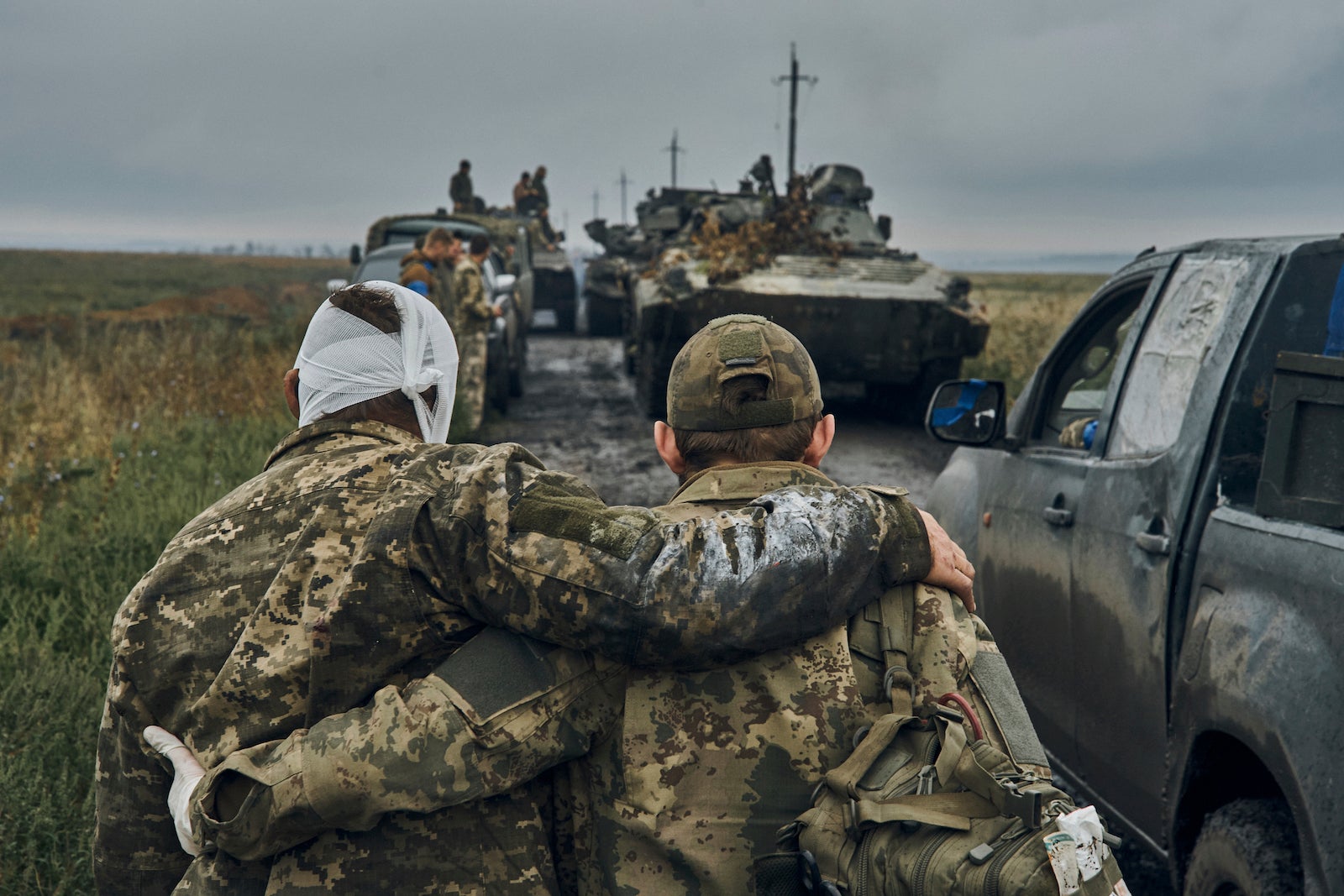
After four years of unyielding warfare, the conflict in Ukraine has reshaped far more than the nation’s frontiers, influencing everything from contemporary battle strategies to the core of international alliances, with consequences now reaching across the globe.
What started as a sweeping invasion has shifted into a drawn‑out confrontation that is reshaping military strategy, diplomatic relations and global power dynamics. For Ukraine, staying alive has required relentless adaptation under relentless attack. For Europe, the conflict has revealed weaknesses that years of relative calm had kept hidden. For the United States and other international players, it has triggered a reevaluation of obligations once seen as unwavering.
On the ground, Ukrainians continue to shoulder the heaviest burden. Soldiers, medics and civilians alike describe a reality defined by attrition, anxiety and adaptation. Many express determination not because optimism comes easily, but because they see no viable alternative. The desire for the war to end is universal inside Ukraine, yet the path to that outcome remains elusive. Meanwhile, in Western capitals, fatigue has set in—both financial and political—creating a paradox in which the very reluctance to sustain support prolongs the conflict it seeks to escape.
Diplomacy unmoored from tradition
A notable transformation has emerged within the sphere of international diplomacy, where the once‑established frameworks guiding peace efforts—defined by precise red lines, coordinated multilateral meetings, and gradual compromises—have increasingly been replaced by more ad‑hoc and transactional methods.
Under President Donald Trump, the United States signaled a departure from traditional diplomatic practices, and interactions with Russian President Vladimir Putin often shifted from established protocols toward efforts aimed at quick, attention-grabbing breakthroughs. However, even with bold gestures and confident public claims of imminent peace, concrete outcomes have remained scant.
Brief pauses centered on energy infrastructure, additional penalties targeting Russian oil, and repeated discussion rounds in multiple international settings have produced scarcely any meaningful movement. Even top US officials have admitted they are unsure of Moscow’s aims. The constant cycle of talks, with shifting formats, intermediaries, and priorities, has failed to deliver lasting accords.
European allies, often caught between loyalty to Washington and fear of Russian aggression, have struggled to maintain coherence. Public displays of unity mask underlying unease about the future of transatlantic security. The absence of decisive outcomes has reinforced a sense of diplomatic drift, in which meetings proliferate but momentum stalls.
For Ukraine, this drift’s price is counted not through official statements but through lives lost and territory surrendered, and the war’s persistence highlights a stark truth: without enforceable leverage, diplomatic ingenuity seldom drives meaningful shifts on the battlefield.
The drone war and the automation of violence
The conflict’s most lasting shift is likely technological, as Ukraine has effectively turned into a testing ground where drone warfare evolves at remarkable speed, squeezing development timelines into just weeks and pushing advances that previously demanded years of study and acquisition to emerge almost instantly on the front lines.
By late 2023, attack drones were filling critical gaps in Ukraine’s defensive capabilities. Shortages of artillery shells and infantry units forced commanders to rely increasingly on unmanned systems. Workshops near the front began assembling first-person-view drones capable of striking armored vehicles and entrenched positions with precision.
As both sides evolved their tactics, the technology became increasingly advanced. Accounts have detailed drones fitted with motion detectors, capable of lingering on their own and detonating once soldiers draw near. Interceptor drones have begun pursuing rival drones in flight, transforming the airspace into a multi‑tiered battleground of automated predators and targets.
Western militaries have been observing intently, aware that the insights arising from Ukraine could influence upcoming conflicts. Rapid adaptation has put pressure on long‑standing procurement processes and strategic planning. For Ukrainian operators, the consequences are urgent, as innovation represents not a theoretical pursuit but a question of survival.
Tymur Samosudov, who leads a drone unit defending southern cities from Iranian-designed Shahed drones deployed by Russia, describes a relentless race. What proves effective one month may be obsolete the next. The inability to pause—even briefly—creates a constant state of urgency. Yet despite exhaustion, operators take pride in their ingenuity, pointing to heavy Russian casualties as evidence that technological creativity can offset numerical disadvantage.
The democratization of lethal capability through relatively inexpensive drones has altered the calculus of warfare. Smaller units can inflict outsized damage, but they also face unprecedented vulnerability. The psychological toll of knowing that unseen devices may be hovering overhead is immense. The battlefield has become not only mechanized but omnipresent.
Europe’s security profile faces mounting pressure
Beyond the trenches, the war has forced Europe to reconsider its security architecture. For decades, the continent relied on the implicit guarantee that the United States would serve as the ultimate defender against external threats. NATO’s credibility rested on that assurance.
Recent years have exposed the fragility of this assumption. As Washington recalibrates its global priorities, European governments confront the possibility that they must assume greater responsibility for their own defense. Yet political realities complicate swift action.
In the United Kingdom, France and Germany, centrist leaderships are navigating internal pressures driven by fiscal limits and populist groups wary of prolonged military investment, and pledges to raise defense spending to 5% of national income are often described as ambitions projected nearly a decade ahead, extending far past the terms of many current leaders.
Meanwhile, evidence of Russian aggression has not been confined to Ukraine. Stray drones have crossed into European airspace, and alleged sabotage operations have targeted infrastructure across the continent. Despite these warning signs, some policymakers continue to argue that Russia’s resources are dwindling and that time may favor the West.
This belief, which holds that financial pressure and limited manpower will eventually erode Moscow’s strength, has become a central pillar of European strategy. For now, however, it remains more an assumption than a guaranteed outcome. Lacking a well‑defined fallback plan if Russia proves more resilient than expected, Europe risks misjudging the magnitude of the challenge.
The war has, in turn, reshaped the very notion of what it means to be European, demonstrating that security cannot be delegated without repercussions, leaving open the question of whether political resolve will rise to meet the rhetoric that recognizes this new reality.
A shifting global balance of power
The conflict has also accelerated broader changes in the international system. The United States, once unambiguously committed to global leadership, appears increasingly selective in its engagements. Official strategy documents emphasize great powers separated by oceans, hinting at a more regionalized approach to influence.
China has navigated a careful path, refraining from providing direct military support that would guarantee Russian victory while maintaining economic ties that sustain Moscow’s war effort. By purchasing Russian oil and exporting dual-use technologies, Beijing has positioned itself as both partner and beneficiary, gradually shifting the balance within its relationship with the Kremlin.
India, traditionally seen as a key US partner in Asia, has similarly balanced its interests. Access to discounted Russian energy has proved economically attractive, even as trade negotiations with Washington influence policy adjustments.
This multipolar dynamic reflects a world no longer tightly bound by dual alliances, as nations follow practical objectives, balancing economic incentives with broader geopolitical choices. For Ukraine, the consequences are significant, since the war has shifted from being a merely regional struggle to becoming a central catalyst in global realignment.
The personal toll and the psychology behind perseverance
Amid strategic assessments and shifting geopolitical currents, the everyday reality of Ukrainians remains at the forefront, with soldiers at the front enduring a fourth year of war whose violence has not eased; exhaustion is widespread, enlistment shortages burden units already thinned by casualties, and command hierarchies at times struggle under the strain of accelerated promotions and constrained training.
Katya, a military intelligence officer who has been assigned to several of the most volatile sectors, portrays exhaustion as the dominant feeling, noting how years without genuine rest steadily diminish resilience, yet she remains in service, sustained by a sense of obligation and the lack of other options.
Civilians confront their own turmoil, as towns once viewed as relatively secure now suffer frequent drone and missile attacks. Yulia, previously employed in hospitality before her city was partly devastated, recently chose to move after the bombardments intensified. Her boyfriend has been conscripted. Everyday routines, with restaurants operating and shops stocked, continue even as air-raid sirens howl without pause.
Demographic consequences are mounting. Ukraine confronts a future shaped by widows, orphans and a shrinking workforce. The social fabric has been stretched by displacement, grief and prolonged uncertainty. Even officials who once believed cultural ties with Russia would prevent full-scale invasion admit lingering shock that the war occurred at all.
Yet alongside trauma, defiance still emerges. Drone operators arrange gender reveal festivities, releasing colored smoke from their unmanned aircraft. Soldiers describe a sense of invincibility, framing it less as bravado and more as essential for survival. The belief that Ukraine must endure, regardless of consistent external support, upholds morale even when no assurances exist.
The paradox remains stark. Western nations express a desire for the conflict to end, citing economic strain and defense expenditures. But insufficient or inconsistent support may extend the very struggle they hope to conclude. Europe’s attempt to economize today risks far greater costs should instability spread to NATO’s borders.
Four years later, the war in Ukraine has become a defining rupture in contemporary history, reshaping warfare through automation, straining diplomatic conventions, testing alliances and revealing the constraints of global leadership, while placing a profound human burden on a society compelled to endure unremitting pressure.
The future trajectory of the conflict remains uncertain. What is clear is that its consequences already extend far beyond Ukraine’s front lines. The world that emerges from this prolonged confrontation will bear the imprint of decisions made—or deferred—during these pivotal years.